Production / Variable Load Supports
Variable load spring supports are spring devices used to bear the weight of piping systems that experience vertical displacements at their support points due to thermal variations.
The variable load support consists of a preloaded helical spring enclosed in a cylindrical housing, equipped with load and travel indicators.
Depending on their field application, there are different types of elastic supports and various types of connections. The figure below lists all the available configurations for variable load elastic supports:


Selection of the Elastic Support
The type must be chosen according to the connection to the supporting structure on site.
If the support is fixed above the piping, it is defined as a “hanger” type, and models A–E are used. For spring supports installed below the piping, type F is selected.
The size of the elastic support is determined based on load data, vertical travel, and the weight to be supported.
Installation Instructions
The variable load spring support must be secured to the supporting structure. By rotating the turnbuckle, the support is adjusted to the cold load index. The travel blocks must be removed before the piping is put into operation. In this way, due to thermal variations, the support will move toward the hot load index.


Production / Roller supports
Roller supports are essential components in the installation of rigid and insulated piping systems that exert a high vertical load, as well as in situations where it is necessary to eliminate friction at the support point caused by thermal expansion of the pipe itself.
The roller body and supporting frame (cage) are made of galvanized carbon steel, while the pin connecting them is made of stainless steel AISI 304, with self-lubricating PTFE-based bushings featuring low static and dynamic friction.
Rollers are manufactured in different types depending on the vertical load and pipe diameter to be supported. Some models also allow a lateral displacement of up to 60 mm to compensate for possible misalignments or side movements.

Roller Supports Type PM
These are also used to support non-insulated pipes but cannot provide lateral guidance as they are not conical. This characteristic makes them suitable where intentional movements are required — for instance, when the piping needs small displacements to compensate for others generated by the connected sections. They are often used in sets of three as lateral guides. The frame and roller are made of white galvanized carbon steel, the pin is stainless steel, and the bushing is PTFE-based with low static and dynamic friction.

Roller Supports Type PE
These are used to support non-insulated pipes and provide minimal guidance thanks to their conical shape. The frame and roller are made of white galvanized carbon steel, while the pin is stainless steel and the bushing is PTFE-based with low static and dynamic friction.

Roller Supports Type CX
CX roller supports are designed for large-diameter, non-insulated piping. They eliminate friction and guide the pipe axially thanks to their conical shape. CX roller supports can be installed either horizontally or vertically with respect to the pipe. The frame and rollers are made of white galvanized carbon steel, while the pins are stainless steel and the bushings are PTFE-based with low static and dynamic friction.


Roller Supports Type PT and SEL
These are used with insulated pipes. They consist of the actual support (PT) and a saddle (SEL), which is welded to the upper part of the steel pipe, while the lower part rests on the roller.In this way, the saddle becomes integral with the pipe and allows it to slide on the roller while being insulated. The frame and roller are made of white galvanized carbon steel, while the pin is stainless steel and the bushing is PTFE-based with low static and dynamic friction.
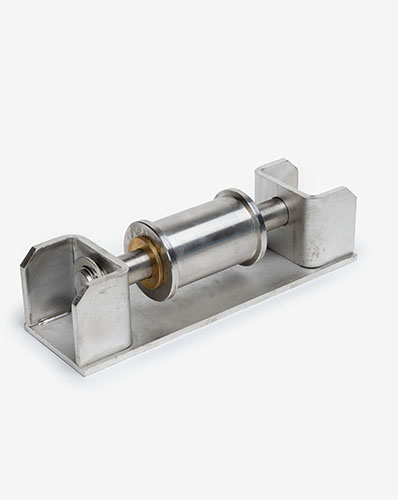

Supporti a rullo tipo PTS e SEL
PTS roller supports are used to support insulated pipes and allow both longitudinal and lateral sliding. This type of roller consists of a roller support (PTS) and a saddle (SEL), which is welded to the steel pipe, while the lower part rests on the roller. The frame and roller are made of white galvanized carbon steel, while the pin is stainless steel and the bushing is made of low-friction PTFE